The Odyssey
Epic by Homer
Short on time? Click here
The best novel ever written
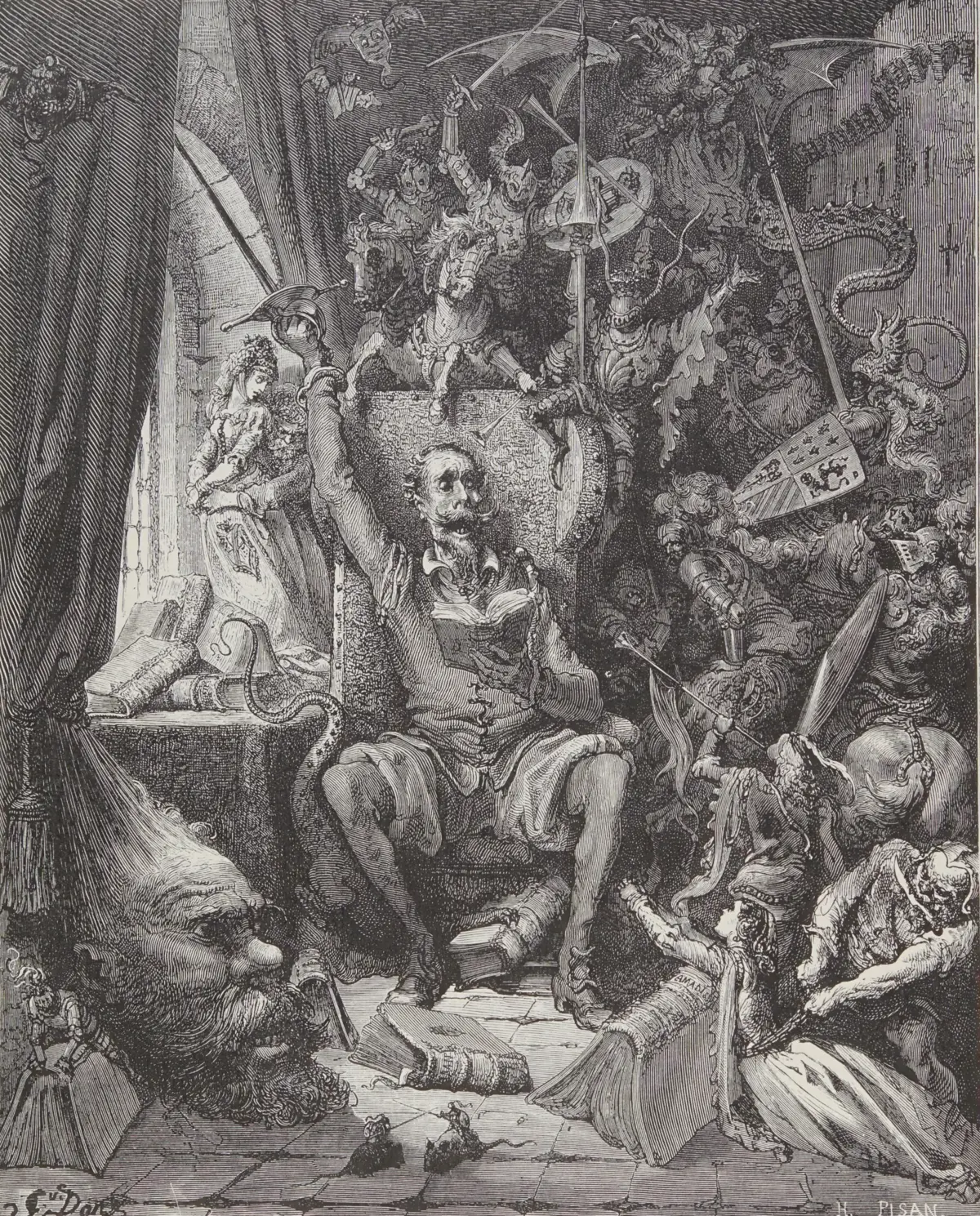
The ingenious gentleman Don Quixote de la Mancha is the best novel ever written in the History of Universal Literature. This is said by many and endorsed by several great writers throughout history. It is no wonder; the work is indeed magnificent, with a great comedic and tragic charge at the same time. The universe that Cervantes creates allows for many interpretations, and, as Calvino said regarding why to read the classics: it is a work that never exhausts what it has to say.
Don Quixote is the story of a man, Alonso Quijano, in his fifties, who owns a small farm in La Mancha, Spain, and has a library with many chivalric books. After reading them so much, he loses his sanity and decides to become a knight-errant himself. He names his steed with the pompous name of Rocinante, adopts a lady to whom he will dedicate his feats, a peasant woman he will call Dulcinea del Toboso, and sets out on adventures. His first outing results in a beating he takes after confronting a group of merchants, which leads him to return home, but still longing to venture out into the world again in search of adventures. He then invites a humble neighbor, a peasant named Sancho Panza, to be his squire, promising to reward him with the governance of an island. The two set out, and from then on unfolds a story full of comedic events, where Don Quixote will demonstrate the degree and type of his madness, while Sancho, despite seeing his master's madness, does not oppose following him. At the end of the first book, Don Quixote returns home, once again sulking after a beating (poor him, he gets beaten a lot throughout the story...), so in the second book, after recovering, he plans his third outing, now famous throughout Spain due to a book circulating that tells of his feats. This fact leads him to encounter various characters who will mock him, pretending to believe in his status as a knight-errant. At the end of the second book, Don Quixote returns home, defeated in a false battle that forces him to withdraw; however, he falls ill and, moments before dying, regains his sanity, dictating his will.
The work addresses aspects of the context of the Spanish Empire in the early 1600s. The Arabic presence and its influence on the culture and daily lives of the characters are very marked. Cervantes presents admirable aspects of literary composition, such as narrating the story as if it were a record from the testimony of another narrator, Cide Hamete Benengeli, a Moorish author whose writings the author of the work we read found and uses as the basis for his narration. Such a device makes it impossible to establish complete trust in the narrator, given that the narrated events would not be primary sources and could be inventions and distortions. We will see, centuries later, the same device used by Machado de Assis in the book Esaú e Jacó, narrating a story, according to him, secondhand, by transcribing part of the memoirs of Counselor Aires. Cervantes also plays with this aspect of the story when, in the second book, he inserts the first book, by Cide Hamete, into the Universe of Don Quixote. The book is written and printed while Don Quixote is recovering at home during the interval between the two volumes. Don Quixote receives information from the bachelor Sansón Carrasco, who states that “children handle it, young men read it, men understand it, and old men celebrate it.” This happens because when Cervantes writes the first volume of Don Quixote, publishing it in 1605, the work becomes popular with the public and gains great fame. However, in 1614, a false continuation of Don Quixote is published, and Cervantes, feeling spiteful, writes and publishes the true second part of the work in 1615, including all these aspects of the real fame of the work and the false continuation. It is no coincidence that Cervantes kills off Don Quixote at the end to leave no doubt that no one will perpetuate false continuations.

Comments
Be the first to comment!
Leave a comment
All comments are moderated before publication.